

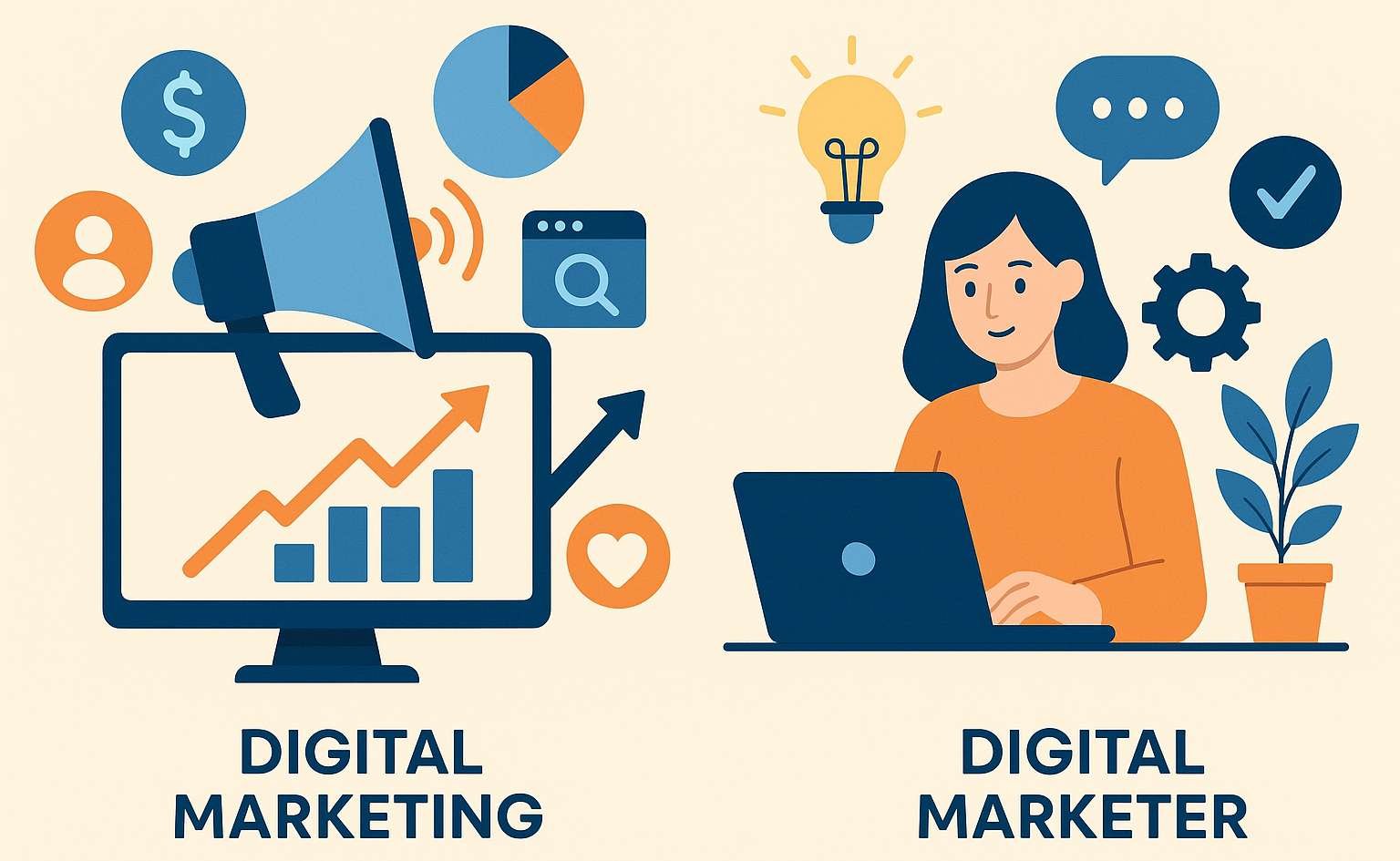
Look, I’m not gonna sugarcoat it—choosing a career path in 2025 feels like standing at a buffet with 500 options while everyone’s shouting different advice at you. But here’s the thing: digital marketing might just be the smartest bet you can make right now. And I’m not just saying that because it sounds cool.
Why Digital Marketing? (And Why Right Now?)
Let me hit you with some real talk. While your friends are stressing about whether their degree will still matter in five years, digital marketing is literally eating the world. Every single business—from your local coffee shop to Fortune 500 companies—needs people who can navigate the digital landscape. It’s not a trend; it’s the new baseline.
Is digital marketing in demand? Hell yes. We’re talking about an industry that’s not just growing—it’s exploding. Companies are throwing money at people who can actually deliver results online. And unlike some fields where you need a decade of experience just to get your foot in the door, digital marketing rewards hustle, creativity, and results over pedigree.
The Real Digital Marketing Roles (Not the BS Job Titles)
Let’s break down the actual digital marketing roles that companies are hiring for right now—not the made-up positions you see on LinkedIn that mean absolutely nothing.
1. Content Marketing Specialist
This is where storytelling meets strategy. You’re creating blog posts, videos, podcasts, and whatever medium makes sense for your brand. But here’s what separates the pros from the amateurs: you’re not just creating content—you’re creating content that converts.
What you actually do:
- Develop content strategies based on data, not vibes
- Write/produce content that ranks on search engines
- Understand your audience so well you can predict what they’ll click before they do
- Measure everything (views, engagement, conversions—all of it)
Real-world scenario: I once worked with a startup that was bleeding money on paid ads. We shifted to a content-first strategy, created 40 pieces of high-value content in 3 months, and organic traffic jumped 340%. The content is still driving leads two years later. That’s the power of good content marketing.
2. Social Media Manager
Forget what you think you know. This isn’t just posting pretty pictures on Instagram. Real social media managers are part psychologist, part data analyst, part creative director, and part crisis manager.
What you actually do:
- Build communities, not just follower counts
- Create content calendars that align with business goals
- Monitor trends and jump on opportunities fast
- Handle customer service (yes, really)
- Run paid social campaigns with ROI that makes CFOs smile
Pro tip: The brands winning on social right now aren’t the ones with the biggest budgets—they’re the ones with the best understanding of platform-specific behavior. TikTok isn’t just short-form Instagram. Twitter isn’t LinkedIn with a character limit. Master the nuances, and you’ll win.
3. SEO Specialist
If content marketing is the art, SEO is the science. You’re the person who makes sure when someone Googles something your company cares about, you show up. Preferably first.
What you actually do:
- Keyword research that goes way beyond Google’s basic tools
- Technical SEO (yes, you’ll need to understand some code)
- Link building (the ethical kind)
- Constant algorithm adaptation (Google changes the rules constantly)
Reality check: SEO takes time. Anyone promising first-page rankings in 30 days is selling snake oil. But done right? SEO is the gift that keeps giving. I’ve seen companies generate millions in revenue from organic search because they invested in solid SEO three years ago.
4. PPC/Paid Advertising Specialist
This is for the data nerds who love instant gratification. You’re managing ad budgets across Google Ads, Facebook Ads, LinkedIn Ads, TikTok Ads—basically anywhere you can pay to play.
What you actually do:
- Set up and optimize ad campaigns
- A/B test everything (headlines, images, copy, audiences)
- Manage budgets (sometimes massive ones)
- Track conversions and ROI obsessively
- Stay updated on platform changes (they happen weekly)
The truth about paid ads: They’re expensive, and if you don’t know what you’re doing, you can burn through budgets faster than you can say “click-through rate.” But master this skill? Companies will throw money at you. Literally.
5. Email Marketing Specialist
“Email is dead,” they said in 2010. They were wrong. Email marketing consistently delivers the highest ROI of any digital marketing channel. Period.
What you actually do:
- Build and segment email lists
- Create automated email sequences
- Write emails people actually want to open
- Test subject lines, timing, and content
- Ensure deliverability (avoiding spam folders is an art)
Real numbers: The average ROI for email marketing is $42 for every $1 spent. Show me another channel with that kind of return.
6. Marketing Analytics/Data Analyst
If you love spreadsheets and finding patterns in chaos, this is your calling. You’re the person who tells everyone else whether their campaigns are actually working or just burning money.
What you actually do:
- Set up tracking and analytics
- Build dashboards and reports
- Identify trends and opportunities
- Translate data into actionable insights
- Prove (or disprove) ROI
Why this matters: In a world where everyone’s making decisions based on “gut feeling,” being the person with actual data is a superpower.
What Do Marketers Actually Do All Day?
Let me paint you a realistic picture because the Instagram version of marketing careers is bullshit.
Morning: Check campaign performance from yesterday. Something always breaks overnight—an ad got disapproved, website traffic dropped, or a social post went viral (for better or worse).
Mid-morning: Meetings. Lots of them. You’re aligning with sales, updating leadership, brainstorming with creative teams.
Afternoon: Execution. Writing copy, setting up campaigns, analyzing data, optimizing what’s running, planning what’s next.
Late afternoon: More meetings. Reviewing results, adjusting strategies, putting out fires.
Evening (sometimes): Checking on campaigns because digital marketing doesn’t sleep, and neither does your anxiety about that big campaign launch.
It’s not glamorous. It’s not all creative brainstorming sessions and viral videos. It’s data, testing, failing, iterating, and occasionally crushing it.
The Marketing Salary Question Everyone Asks
Let’s talk money because that’s what you’re really wondering about.
Entry-level (0-2 years): $40k-$55k You’re learning, making mistakes, and building your portfolio. It’s not sexy, but everyone starts here.
Mid-level (3-5 years): $55k-$85k You’ve proven you can deliver results. You’re managing campaigns solo and maybe leading a small team.
Senior-level (5-10 years): $85k-$130k+ You’re the expert. Companies pay for your strategic thinking and proven track record.
Leadership (10+ years): $130k-$250k+ CMO, VP of Marketing, Director-level positions. You’re making big decisions and managing teams.
Reality check: These numbers vary wildly based on location, company size, and industry. A social media manager at a tech startup in San Francisco makes very different money than one at a local agency in Des Moines. Also, freelancers and consultants can make significantly more—or less—depending on their hustle and client base.
Digital Marketing Income: The Full Picture
Here’s what they don’t tell you: your income in digital marketing isn’t just your salary.
Side hustles are everywhere:
- Freelance clients ($500-$5,000+ per project)
- Consulting ($100-$500+ per hour)
- Online courses/coaching
- Affiliate marketing
- Your own digital products
I know marketers making $70k at their day job who pull in another $50k-$100k from side projects. The skills are that transferable.
But also: You need to actually be good. The internet is full of “marketing experts” who can’t deliver results. Be the person who can actually move metrics, and the money will follow.
How to Actually Break Into Digital Marketing
Forget the traditional path. Here’s what actually works in 2025:
1. Learn by Doing (Not Just Courses)
Take courses, sure. But more importantly, DO stuff:
- Start a blog or YouTube channel
- Run a small business’s social media (offer to do it for free initially)
- Create a portfolio project that shows results
- Launch your own small campaigns with your own money
Example: One of the best hires I ever made was someone who had grown their personal TikTok to 100k followers by understanding the algorithm. They didn’t have a marketing degree. They had results.
2. Specialize, Then Expand
Don’t try to be great at everything immediately. Pick one area (SEO, paid ads, content, etc.) and go deep. Once you’re competent, start adding skills.
3. Build in Public
Share what you’re learning on LinkedIn, Twitter, or wherever your audience hangs out. Document your wins and failures. This builds your personal brand and attracts opportunities.
4. Get Certifications (The Right Ones)
Some certifications matter:
- Google Ads Certification
- Google Analytics Certification
- HubSpot Content Marketing Certification
- Meta Blueprint Certification
Others are basically expensive PDFs. Do your research.
5. Network Like Your Career Depends On It (Because It Does)
Join marketing communities, attend virtual events, comment thoughtfully on industry leaders’ posts. Most opportunities come from connections, not cold applications.
The Challenges Nobody Talks About
Let’s keep it real—digital marketing isn’t all sunshine and viral posts.
Challenge 1: Constant Change The platforms change algorithms constantly. What worked last month might not work today. You need to be comfortable with perpetual learning or you’ll become irrelevant fast.
Challenge 2: Proving ROI Everyone wants to know: “What’s the return on this marketing spend?” Sometimes it’s clear. Often, it’s complicated. You need to get comfortable with ambiguity and get creative with attribution.
Challenge 3: Burnout The always-on nature of digital marketing can be exhausting. You’re constantly connected, and there’s always more you could be doing. Setting boundaries is crucial.
Challenge 4: Dealing with Everyone’s “Expert” Opinion Everyone thinks they understand marketing because they use social media. You’ll spend a lot of time explaining why the CEO’s nephew’s TikTok idea probably won’t work for a B2B SaaS company.
The Future: Where Digital Marketing is Heading
AI is changing everything. But here’s the nuance: AI isn’t replacing marketers—it’s replacing marketers who refuse to adapt.
What’s coming:
- AI-powered content creation (you’ll need to learn to direct AI, not just write from scratch)
- Hyper-personalization at scale
- Privacy-first marketing (cookies are dying, first-party data is king)
- More video, more audio, more interactive content
- Community-led growth overtaking traditional advertising
What this means for you: The fundamentals still matter (understanding human psychology, crafting compelling messages, analyzing data), but the tools are evolving fast. Stay curious, stay flexible.
Final Thoughts: Is Digital Marketing Right for You?
Here’s the honest truth: Digital marketing is perfect for you if:
- You’re comfortable with constant change and learning
- You like seeing direct results from your work
- You’re both creative AND analytical
- You don’t need someone holding your hand
- You’re okay with some uncertainty
It’s probably NOT for you if:
- You want a job where you do the same thing every day
- You need long-term stability and predictability
- You hate data and spreadsheets
- You’re not willing to keep learning
Your Next Steps
Stop overthinking and start doing:
- This week: Pick one digital marketing channel and consume everything you can about it
- This month: Launch a small project (blog, social account, small ad campaign)
- Next 3 months: Apply for entry-level roles or freelance gigs while building your skills
- Next year: Be working in digital marketing with a clear path forward
Digital marketing career paths aren’t linear. They’re messy, full of pivots, and honestly? That’s what makes them exciting. You’re not locked into one trajectory. You can start in content, move to paid ads, shift to strategy, or even start your own agency.
The opportunities are massive. The field is growing. And the barrier to entry is lower than almost any other career that pays this well.
So yeah—if you’re young, ambitious, and willing to put in the work? Digital marketing is one hell of a career path.
Now stop reading and go build something.










Satu Komentar
good