
Okay, real talk: if you’re running a business in 2024 and you’re not doing SEM marketing, you’re basically leaving money on the table. Like, stacks of it. But here’s the thing—most people confuse SEM with SEO, throw some money at Google Ads, then wonder why their bank account is crying while their conversions are ghosting them.
Let me fix that for you. This guide is going to break down SEM marketing in a way that actually makes sense, without the corporate jargon or the “guru” nonsense. We’re talking real strategies, actual numbers, and actionable tactics you can implement today.
What the Heck is SEM Marketing Anyway?
SEM stands for Search Engine Marketing, and before you roll your eyes thinking it’s just another acronym to memorize, let me explain why this matters to your wallet.
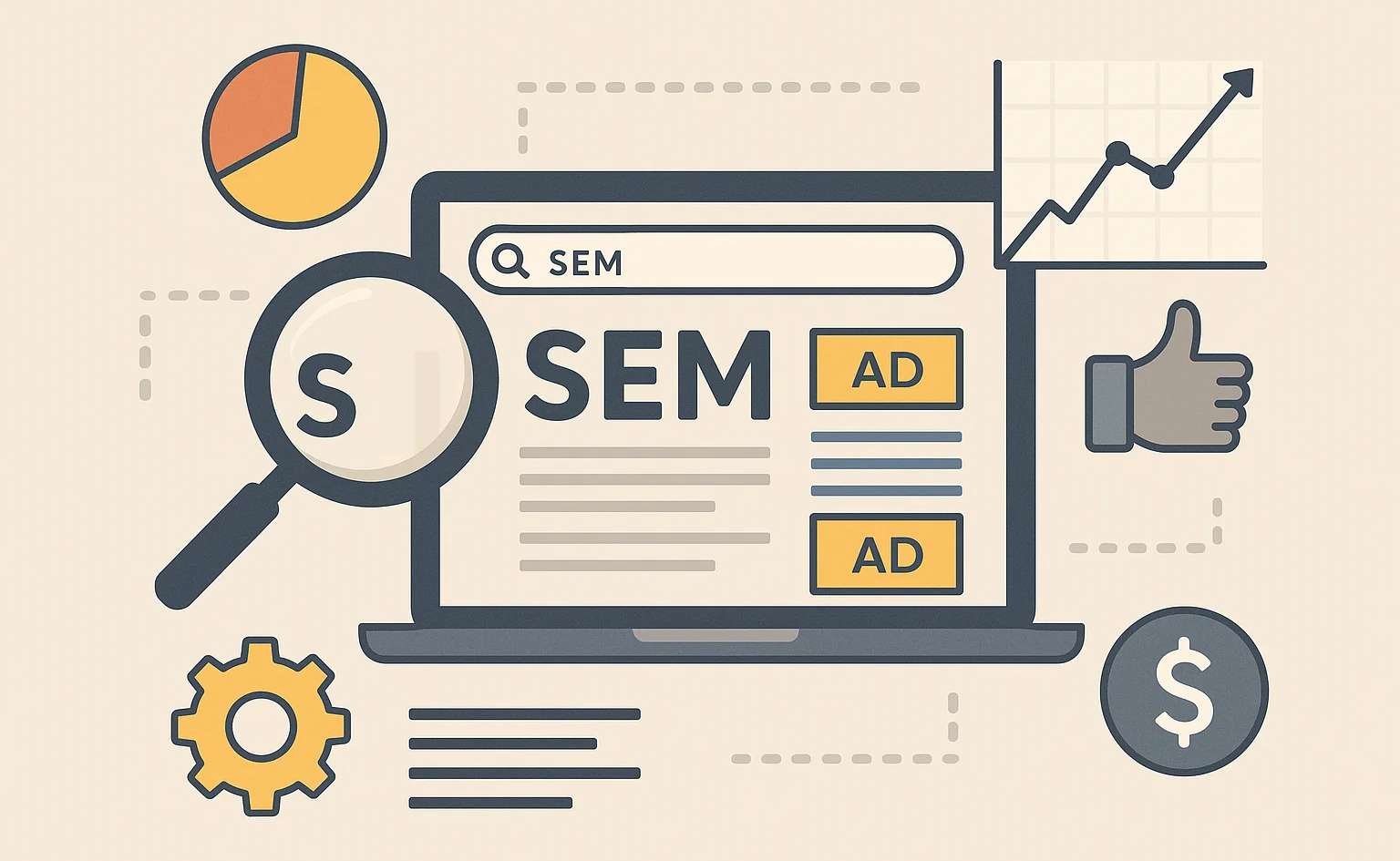
SEM marketing is basically paying to show up at the top of search results when people look for stuff related to your business. You know those ads that appear above organic search results with “Sponsored” or “Ad” labels? That’s SEM in action.
The beauty of SEM? You’re putting your business in front of people who are actively searching for what you offer. These aren’t random scrollers—they’re potential customers with intent. And intent, my friend, is marketing gold.
SEM vs SEO: Understanding the Difference
Here’s where people get confused. SEO (Search Engine Optimization) is the free, organic way to rank in search results. It takes time, consistent content, and a lot of patience. SEM? You’re paying for visibility, and you get results fast.
Think of it like this:
- SEO = Planting a garden and waiting for it to grow (free but slow)
- SEM = Buying vegetables from the farmers market (costs money but instant)
Both are important. SEO builds long-term authority, while SEM gives you immediate traffic and data. Smart marketers use both.
Types of Search Marketing You Need to Know
When we talk about types of search marketing, we’re really discussing the different ways you can get found online. Let’s break down the main players:
1. Pay-Per-Click (PPC) Advertising
This is the heavyweight champion of SEM. You bid on keywords, create ads, and pay only when someone clicks. Google Ads dominates here, but Bing Ads (yes, it still exists and can be profitable) is also an option.
2. Shopping Ads
If you’re selling physical products, these are your best friend. They show product images, prices, and store info right in search results. E-commerce businesses, pay attention.
3. Display Advertising
Banner ads across Google’s Display Network. These reach people browsing websites, not actively searching. Good for brand awareness and remarketing.
4. Remarketing/Retargeting
Following people around the internet after they visit your site. Creepy? Maybe a little. Effective? Absolutely. Someone visited your site but didn’t buy? Remarketing brings them back.
5. Local Search Ads
For local businesses wanting to show up in “near me” searches. If you run a coffee shop, restaurant, or service business, this is crucial.
6. Video Ads
YouTube is the second-largest search engine. Video ads on YouTube and across Google’s network can drive serious results, especially for visual products or services.
How to Calculate SEM: The Numbers That Actually Matter
Let’s talk money because that’s what you really care about, right? Understanding how to calculate SEM ROI is crucial. If you can’t measure it, you can’t improve it.
Here are the key metrics and formulas:
Cost Per Click (CPC)
CPC = Total Cost / Total Clicks
If you spent $500 and got 200 clicks, your CPC is $2.50. Simple.
Click-Through Rate (CTR)
CTR = (Clicks / Impressions) × 100
If your ad was shown 10,000 times and got 200 clicks, your CTR is 2%. Industry average is 2-5%, so aim higher.
Conversion Rate
Conversion Rate = (Conversions / Clicks) × 100
Out of 200 clicks, if 10 people bought something, your conversion rate is 5%. This is where the magic happens.
Cost Per Acquisition (CPA)
CPA = Total Cost / Total Conversions
Spent $500, got 10 sales? Your CPA is $50. Know this number inside and out.
Return on Ad Spend (ROAS)
ROAS = Revenue from Ads / Cost of Ads
Generated $2,000 in revenue from $500 in ads? Your ROAS is 4:1 or 400%. Anything above 3:1 is generally solid, but it varies by industry.
Quality Score
Google assigns your ads a Quality Score (1-10) based on relevance, landing page experience, and expected CTR. Higher scores = lower costs and better ad positions. It’s not a calculation you do, but you need to monitor it religiously.
Crafting Killer SEM Copy That Actually Converts
Here’s a truth bomb: SEM copy can make or break your campaigns. You could have perfect targeting and a huge budget, but if your ad copy sucks, you’re toast.
The Anatomy of Great Ad Copy
Headline: You’ve got 30 characters to grab attention. Use power words, include the keyword, and create curiosity or urgency.
Bad: “Buy Shoes Online” Good: “Premium Leather Boots – 40% Off Today”
Description: 90 characters to seal the deal. Highlight benefits, include a clear CTA, and speak directly to pain points.
Bad: “We sell quality shoes at affordable prices.” Good: “Free shipping + returns. Handcrafted boots that last 10+ years. Shop now.”
SEM Copy Formulas That Work
Problem-Agitate-Solve: Identify the problem, make it hurt, then present your solution.
Feature-Advantage-Benefit: Don’t just list features—explain why they matter.
Before-After-Bridge: Show the current state, the desired state, and how you bridge the gap.
Testing Your Copy
Never, ever run just one ad. Create 3-5 variations testing different:
- Headlines
- Value propositions
- CTAs (Call-to-Actions)
- Emotional triggers
Let them run for at least 100 clicks each, then double down on winners and kill the losers. No emotions, just data.
SEM Display: Expanding Beyond Search
SEM display takes your ads beyond search results and places them across millions of websites in Google’s Display Network. We’re talking news sites, blogs, YouTube—anywhere with ad space.
Display ads work differently than search ads:
Visual First: Your image or video is the star. Make it pop.
Audience Targeting: You’re not targeting keywords but audiences based on demographics, interests, and behavior.
Brand Awareness: Display is less about immediate conversions and more about staying top-of-mind.
Display Best Practices
- Use high-quality, attention-grabbing images
- Keep text minimal (20% rule still matters in some placements)
- Test multiple sizes (300×250, 728×90, 160×600 are standard)
- A/B test different creative approaches
- Set frequency caps so you don’t annoy people
- Use remarketing lists to target people who’ve visited your site
Display ads typically have lower CTRs than search ads (0.5-1% is normal), but they’re cheaper and great for building awareness.
Learn SEM: Your Roadmap to Mastery
Want to learn SEM properly? Here’s the no-BS path from beginner to competent:
Month 1: Foundation
- Understand how search engines work
- Learn Google Ads interface inside and out
- Study keyword research fundamentals
- Master ad copy basics
- Set up conversion tracking (this is non-negotiable)
Month 2-3: Campaign Building
- Launch your first search campaign with small budget
- Experiment with different ad types
- Learn audience targeting options
- Study competitor ads (use SEMrush or SpyFu)
- Dive into Quality Score optimization
Month 4-6: Optimization
- Advanced bidding strategies
- Deep dive into analytics
- A/B testing everything
- Remarketing campaign setup
- Budget allocation strategies
Month 7-12: Scaling
- Automated bidding strategies
- Shopping campaigns (if e-commerce)
- Video ad campaigns
- Advanced audience segmentation
- Multi-channel attribution
Free Learning Resources
- Google Skillshop (free certifications, actually useful)
- PPC Hero blog (industry insights without fluff)
- Search Engine Journal (stay updated on changes)
- YouTube channels: Surfside PPC, Solutions 8
- Join communities: r/PPC on Reddit, PPC Chat
Paid Resources Worth It
- Google Ads certification prep courses ($10-50)
- Udemy courses during sales (wait for $15 deals)
- Isaac Rudansky’s courses (actually good, not just hype)
The best learning? Spend your own money on campaigns. Even $200-300 will teach you more than any course. Make mistakes, lose some money, learn what works.
Common SEM Mistakes (And How to Avoid Them)
Let me save you from the pain I’ve experienced and witnessed:
1. Ignoring Negative Keywords
Not using negative keywords is like leaving your door open and wondering why mosquitoes keep getting in. Add irrelevant terms to your negative keyword list constantly.
2. Sending Traffic to Your Homepage
Unless you’re a massive brand, don’t do this. Create dedicated landing pages that match your ad message. The more aligned your ad and landing page, the better your Quality Score and conversions.
3. Setting and Forgetting
SEM requires constant attention. Check campaigns at least 2-3 times per week. Adjust bids, pause underperformers, test new copy, analyze data.
4. Broad Match Madness
Broad match keywords can drain your budget fast on irrelevant searches. Start with exact and phrase match, then carefully expand.
5. No Mobile Optimization
Over 60% of searches happen on mobile. If your landing page isn’t mobile-optimized, you’re bleeding money.
6. Ignoring Ad Extensions
Ad extensions (sitelinks, callouts, structured snippets) make your ads bigger and more clickable. Use them. Always.
7. Poor Landing Page Experience
Fast loading speed, clear value proposition, obvious CTA, trust signals—these aren’t optional. Your landing page can make or break your campaign.
Advanced SEM Strategies for When You’re Ready
Once you’ve mastered the basics, these advanced tactics can take your campaigns to the next level:
Dynamic Search Ads
Google automatically creates ads based on your website content. Great for large catalogs or when you want to discover new keyword opportunities.
Smart Bidding
Use Google’s machine learning to automatically optimize bids. ROAS bidding, Target CPA, Maximize Conversions—these work when you have enough conversion data.
Audience Layering
Combine keyword targeting with audience targeting. Target your main keywords but bid higher for specific audiences (like past purchasers or high-income demographics).
Competitor Conquest Campaigns
Bid on competitor brand names. Controversial? Maybe. Effective? Absolutely. Just make sure your offer is compelling enough to steal their customers.
Sequential Remarketing
Show different ads based on where someone is in your funnel. Browsers see awareness ads, cart abandoners see discount ads, past customers see new product ads.
The Future of SEM Marketing
SEM is evolving fast. Here’s what’s coming:
AI and Automation: Machine learning is taking over bidding and ad creation. Manual optimization will always matter, but smart marketers leverage automation.
Privacy Changes: With cookies dying and privacy regulations tightening, first-party data and contextual targeting are making comebacks.
Voice Search: More people search by voice. Long-tail, conversational keywords are becoming crucial.
Visual Search: Google Lens and similar tech mean image-based searches are growing. If you sell visual products, optimize for this.
Integration: SEM isn’t standalone anymore. It works best integrated with SEO, social ads, email marketing, and content marketing.
Building Your SEM Stack: Tools You Actually Need
You don’t need every tool under the sun, but these are legitimately helpful:
Essential (Free or Cheap):
- Google Ads (obviously)
- Google Analytics 4 (free, essential for tracking)
- Google Keyword Planner (free keyword research)
- Google Tag Manager (free, makes tracking easier)
Worth Paying For:
- SEMrush or Ahrefs ($99-199/month, competitor research and keyword data)
- Unbounce or Instapage ($79-299/month, landing page builders)
- Hotjar ($39+/month, see how users interact with your pages)
- Optmyzr ($199+/month, campaign management and automation)
Nice to Have:
- SpyFu (competitor ad intelligence)
- CallRail (call tracking if you’re phone-based)
- AdEspresso (if you’re also running Facebook ads)
Start with the essentials, add tools as you scale and as budgets allow.
Real Talk: Is SEM Worth It?
Here’s my honest take after running campaigns for years: SEM is one of the highest-ROI marketing channels when done right. But “when done right” is the operative phrase.
You’ll waste money at first. You’ll make mistakes. Some campaigns will flop. That’s normal. The difference between successful SEM marketers and failed ones isn’t avoiding mistakes—it’s learning from them quickly and not repeating them.
SEM works best when:
- You have a clear understanding of your customer lifetime value
- Your margins support paid acquisition costs
- You commit to testing and optimization
- You have tracking properly set up from day one
- You’re patient enough to let campaigns gather data
SEM might not work if:
- Your profit margins are razor-thin
- You can’t afford to test and lose some money initially
- You’re in an ultra-competitive niche with high CPCs
- You don’t have resources to create good landing pages
Taking Action: Your 30-Day SEM Launch Plan
Stop overthinking. Here’s what you do:
Week 1: Set up Google Ads account, install conversion tracking, research 20-30 relevant keywords, study competitor ads.
Week 2: Create 3 ad groups with tightly themed keywords (5-10 keywords each), write 3-4 ad variations per group, build one solid landing page per ad group.
Week 3: Launch campaigns with $10-20/day budget, monitor daily, add negative keywords as needed.
Week 4: Analyze data, pause underperforming ads and keywords, increase budget on winners, create new ad variations based on learnings.
That’s it. Don’t try to be perfect. Launch, learn, improve.
The Bottom Line
SEM marketing isn’t rocket science, but it does require strategy, patience, and continuous learning. The marketers making bank with SEM aren’t necessarily smarter—they’re just more persistent about testing, analyzing, and optimizing.
Start small, measure everything, kill what doesn’t work, and scale what does. Your competition is probably making at least half the mistakes I mentioned above. Do better, and you’ll win.
The search results page is prime real estate. SEM gives you a way to own it. Now stop reading and start building your first campaign.
Want a free SEM campaign audit? Drop a comment with your biggest SEM challenge, and let’s figure it out together. No fluff, no sales pitch—just real advice from someone who’s been in the trenches.