

Let’s start with a brutal truth: Most businesses are basically gambling with their money. They launch campaigns, hire people, buy software, and cross their fingers hoping it works out. Then, three months later, they’re shocked—SHOCKED—when they can’t figure out if they made money or just lit their budget on fire.
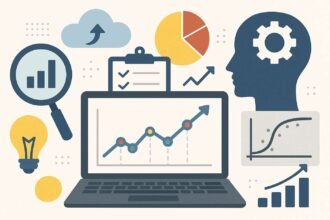
Here’s where predictive ROI comes in. And no, this isn’t some buzzword I’m throwing around to sound smart. This is about actually knowing—before you spend a dollar—whether that dollar is going to come back with friends or disappear into the void.
What the Hell Is Predictive ROI Anyway?
Traditional ROI is looking in the rearview mirror. You spent $10,000 on Facebook ads last month, generated $30,000 in revenue, and boom—you got a 3x return. Cool. But that’s history.
Predictive ROI is looking through the windshield. It’s using data, analytics, and (yes) a bit of strategic thinking to forecast what your return will be BEFORE you commit resources. It’s the difference between “let’s try this and see what happens” and “based on these factors, we expect a 2.5x return within 90 days.”
Think of it like this: Traditional ROI is your report card. Predictive ROI is studying for the test with last year’s answers.
Why Should You Care? (Besides the Obvious Money Thing)
Look, I get it. “Predictive analytics” sounds like something only data scientists at Google should worry about. But here’s why even small businesses and solo entrepreneurs need to get on this train:
1. You Stop Wasting Money on Stupid Bets
I’ve watched companies blow $50k on a rebrand that did absolutely nothing for revenue. Why? Because nobody bothered to model what the actual impact would be. With predictive ROI, you can estimate outcomes and avoid throwing money at things that feel good but don’t move the needle.
2. You Can Actually Scale What Works
When you know what drives returns, you can double down intelligently. Instead of “I think Facebook ads are working,” you can say, “For every $1,000 we spend on Facebook ads targeting this audience, we generate $3,200 in revenue within 30 days. Let’s scale that.”
3. You Get Buy-In From Stakeholders
Try asking your boss or investors for budget by saying “trust me bro.” Now try showing them a model that says, “Based on our current conversion rates and customer lifetime value, this $20k investment should generate $65k over 12 months.” Which one gets approved?
4. You Sleep Better at Night
Real talk: Business anxiety is brutal. Predictive ROI doesn’t eliminate risk, but it replaces blind panic with informed confidence. You’re still making bets, but now you actually know the odds.
The Building Blocks: What You Need to Predict ROI
Before you can predict anything, you need the right ingredients. Here’s what actually matters:
1. Historical Data (The More, The Better)
You can’t predict the future without understanding the past. You need:
- Previous campaign performance
- Sales data over time
- Customer acquisition costs
- Conversion rates at each funnel stage
- Customer lifetime value
- Seasonal trends
Real scenario: I worked with an e-commerce brand that wanted to predict holiday season ROI. We pulled three years of data, noticed that November spending consistently delivered 4.2x ROI while December dropped to 2.8x (market saturation + higher ad costs). They shifted budget accordingly and crushed it.
The catch: If you don’t have data, you can’t be as accurate. But you can still use industry benchmarks as a starting point. Just be honest about the confidence level of your predictions.
2. Clear Metrics That Actually Matter
Not all metrics are created equal. Revenue is obvious, but you also need to track:
- Customer Acquisition Cost (CAC)
- Customer Lifetime Value (CLV)
- Conversion rate by channel
- Average order value
- Churn rate (if applicable)
- Time to conversion
Hot take: If you’re tracking “engagement” or “brand awareness” without tying them to revenue, you’re playing a dangerous game. Those can be leading indicators, but they’re not the end goal.
3. Attribution Models (Know What’s Actually Working)
This is where it gets messy. When someone buys from you, which touchpoint gets credit? Did they find you through:
- That Instagram ad?
- The blog post they read two weeks ago?
- The email you sent?
- All of the above?
Attribution is complex, but you need some model—first-touch, last-touch, or multi-touch—to understand what’s driving conversions. Without this, your predictions are just fancy guesses.
4. Market Context and External Factors
Your predictions don’t exist in a vacuum. Consider:
- Economic conditions (recession vs. boom times)
- Seasonality (B2C crushes Q4; B2B dies in August)
- Competitive landscape (new players entering the market)
- Platform changes (algorithm updates, policy changes)
- Industry trends
Example: In early 2021, iOS 14.5 privacy changes destroyed Facebook ad performance for many advertisers. If your predictive model didn’t account for potential platform risk, you got burned. Hard.
How to Actually Build a Predictive ROI Model (Without a PhD)
Alright, enough theory. Let’s get practical. Here’s how you build a basic predictive ROI model that actually works:
Step 1: Define Your Investment
What are you spending money on? Be specific:
- Paid advertising campaign
- Content marketing initiative
- New hire
- Software/tools
- Product development
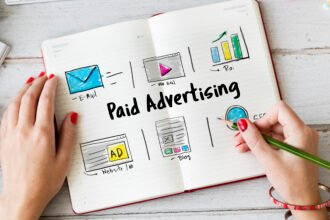
Let’s use an example: You’re planning to spend $10,000 on Google Ads over 30 days.
Step 2: Identify Your Key Metrics
Pull your historical data:
- Average click-through rate (CTR): 3.2%
- Average cost per click (CPC): $2.50
- Landing page conversion rate: 4%
- Average order value: $150
- Customer lifetime value: $450
Step 3: Build the Model
Now do the math:
Budget: $10,000
Expected clicks: $10,000 ÷ $2.50 = 4,000 clicks
Expected conversions: 4,000 × 4% = 160 customers
Immediate revenue: 160 × $150 = $24,000
Lifetime revenue: 160 × $450 = $72,000
Immediate ROI: ($24,000 – $10,000) ÷ $10,000 = 140%
Lifetime ROI: ($72,000 – $10,000) ÷ $10,000 = 620%
Boom. You just predicted ROI.
Step 4: Add Confidence Intervals
Here’s where we get real: Your prediction won’t be perfect. Build in scenarios:
Best case (everything performs 20% better):
- 192 customers
- $28,800 immediate revenue
- 188% immediate ROI
Worst case (everything performs 20% worse):
- 128 customers
- $19,200 immediate revenue
- 92% immediate ROI
Now you know the range. Even in the worst case, you’re still profitable. Green light.
Step 5: Monitor and Adjust
As the campaign runs, compare actual performance to predictions. If you’re way off, update your model. This is how it gets more accurate over time.
Advanced Predictive ROI: Leveling Up
Once you’ve mastered the basics, here’s how the pros do it:
1. Cohort Analysis
Don’t just look at averages. Segment by:
- Acquisition channel (organic vs. paid)
- Customer demographics
- Product category
- Time periods
Different cohorts have different ROI profiles. A customer acquired through content marketing might have lower CAC but higher LTV than one from paid ads.
2. Machine Learning Models
If you have tons of data and want to get fancy, tools like Python’s scikit-learn or even Google’s AutoML can build predictive models that account for dozens of variables simultaneously.
Reality check: This is overkill for most small businesses. But if you’re spending $100k+ monthly on marketing, it’s worth exploring.
3. A/B Testing Integration
Continuously test variables (ad creative, landing pages, offers) and feed those results into your predictive models. Your predictions get sharper when they’re based on tested data, not assumptions.
4. Probability-Weighted Scenarios
Instead of just best/worst/expected case, assign probabilities:
- 60% chance of baseline scenario (2.4x ROI)
- 25% chance of optimistic scenario (3.1x ROI)
- 15% chance of pessimistic scenario (1.8x ROI)
Expected ROI = (0.60 × 2.4) + (0.25 × 3.1) + (0.15 × 1.8) = 2.49x
This gives you a weighted expected value that’s more nuanced than a single prediction.
Real-World Case Studies: Predictive ROI in Action
Let me show you how this plays out in the real world:
Case Study 1: SaaS Startup Avoids a Disaster
A B2B SaaS company wanted to spend $75k on a trade show. Sounds reasonable, right? Everyone does trade shows.
We built a predictive model:
- Expected booth traffic: 500 people
- Conversion to demo: 10% = 50 demos
- Demo to trial: 20% = 10 trials
- Trial to paid: 30% = 3 customers
- Average contract value: $15,000/year
- Expected revenue: $45,000
Predicted ROI: ($45,000 – $75,000) ÷ $75,000 = -40%
They would LOSE money. Instead, they took that $75k, invested it in content marketing and paid search, and generated $180k in revenue over six months. Predictive ROI saved them from a terrible decision.
Case Study 2: E-commerce Brand Scales Intelligently
An online fashion retailer was doing $50k/month on Facebook ads with a 2x ROI. They wanted to scale to $200k/month.
The predictive model showed:
- At $50k spend: 2x ROI (efficient targeting)
- At $100k spend: 1.7x ROI (broader targeting, higher CPMs)
- At $200k spend: 1.3x ROI (audience saturation)
Instead of jumping straight to $200k, they scaled gradually to $120k where ROI stabilized at 1.65x. They made way more profit than if they’d blindly scaled.
Case Study 3: Agency Justifies Retainer Pricing
A marketing agency was struggling to close a client who wanted to negotiate down from $8k/month to $5k/month.
The agency built a predictive ROI model showing:
- At $8k/month (full service): Predicted $32k/month revenue = 4x ROI
- At $5k/month (reduced service): Predicted $15k/month revenue = 3x ROI
The client saw that cutting budget would actually cost them $204k/year in lost revenue. They paid the full retainer.
The Pitfalls: Where Predictive ROI Goes Wrong
Let’s talk about what can screw this up, because it’s not foolproof:
Pitfall 1: Garbage In, Garbage Out
If your historical data is wrong, incomplete, or poorly tracked, your predictions will be trash. You need clean, accurate data as your foundation.
Solution: Audit your data regularly. Fix tracking issues. Be honest about data quality.
Pitfall 2: Ignoring External Factors
Your model says 2.5x ROI, but then:
- A competitor launches a price war
- The economy tanks
- Your industry gets hit with new regulations
- A global pandemic happens (oh wait…)
Solution: Build in risk factors and update predictions as conditions change.
Pitfall 3: Over-Optimizing for Short-Term ROI
Some investments have long payback periods but massive lifetime value. If you only optimize for immediate ROI, you miss huge opportunities.
Example: Content marketing often takes 6-12 months to really pay off. If you kill it at month 3 because “the ROI isn’t there,” you never reach the compounding phase.
Solution: Distinguish between short-term and long-term ROI. Some bets are worth making even with delayed returns.
Pitfall 4: Confusing Correlation with Causation
Just because two things happen together doesn’t mean one caused the other. Your fancy model might show that “sunny days = more sales,” but that doesn’t mean you should invest in weather control.
Solution: Always ask “why” and test causation through controlled experiments when possible.
Pitfall 5: False Precision
Saying “we expect exactly $34,287.53 in revenue” is nonsense. Your model isn’t that accurate. Present predictions as ranges, not exact numbers.
Solution: Use realistic confidence intervals. “We expect $30k-$40k in revenue” is more honest than pretending you know the exact figure.
Tools and Resources for Predictive ROI
You don’t need to build everything from scratch. Here are tools that help:
Free/Cheap:
- Google Sheets (seriously, you can do a lot with spreadsheets)
- Google Analytics (for data collection)
- Facebook Ads Manager (built-in forecasting)
- Google Ads forecasting tools
Mid-Range:
- HubSpot (includes ROI tracking and prediction)
- Salesforce (with analytics add-ons)
- Tableau (for visualization)
- Mixpanel (product analytics)
Enterprise:
- Adobe Analytics
- Custom-built solutions
- Data science teams with Python/R
Start simple. Most businesses can get 80% of the value from a well-built spreadsheet model.
The Psychology of Predictive ROI: Why People Resist It
Here’s a secret: The biggest barrier to predictive ROI isn’t technical—it’s psychological.
People don’t want to be held accountable.
If you predict 2.5x ROI and only deliver 1.8x, that’s uncomfortable. It’s safer to not predict anything and claim victory regardless of results.
People trust their gut more than data.
“I just have a feeling this will work” is how most business decisions get made. Predictive ROI requires admitting that feelings aren’t enough.
People hate being wrong.
When your prediction is off, it feels like failure. But here’s the thing: Being directionally right is way better than being blind.
How to overcome this:
Frame predictive ROI as a learning tool, not a report card. The goal isn’t perfection—it’s making progressively better decisions. Every wrong prediction teaches you something that makes the next one more accurate.
Getting Started Tomorrow
Okay, you’re convinced. Now what?
Week 1: Audit Your Data
- What data do you actually have?
- What’s missing?
- What’s unreliable?
- Set up proper tracking if needed
Week 2: Pick One Initiative to Model
- Start small (don’t try to model your entire business)
- Choose something with clear inputs and outputs
- Build a basic ROI prediction
Week 3: Test Your Model
- Run the initiative
- Track actual vs. predicted performance
- Identify why they differ
Week 4: Refine and Expand
- Update your model based on learnings
- Apply the approach to another initiative
- Start building a library of models
Final Thoughts: The Real Power of Predictive ROI
Here’s what most people miss: Predictive ROI isn’t really about the prediction. It’s about the thinking process.
When you force yourself to model outcomes, you:
- Clarify your assumptions
- Identify knowledge gaps
- Think through potential scenarios
- Make better decisions even if the prediction is wrong
I’ve seen companies transform not because their predictions were perfect, but because the discipline of building predictions made them smarter about their business.
The entrepreneurs and businesses winning right now aren’t the ones with the best instincts—they’re the ones who combine instincts with data. They make educated bets, not blind ones.
The Truth About Uncertainty
Let me level with you one last time: Predictive ROI won’t eliminate uncertainty. Business is inherently uncertain. Markets shift, competitors adapt, shit happens.
But predictive ROI gives you a fighting chance. It’s the difference between stumbling in the dark and walking with a flashlight. You might still trip, but at least you’ll see the obstacle coming.
The businesses that master predictive ROI aren’t just surviving—they’re compounding their advantages quarter after quarter. They cut losses faster, scale winners harder, and allocate resources more efficiently than their competitors.
So stop flying blind. Start predicting. Start measuring. Start learning.
Your future ROI (and your bank account) will thank you.
One last thing: Perfect predictions are impossible. But consistently directional predictions? That’s the game. Play it well, and you’ll run circles around competitors who are still making decisions based on vibes and hope.